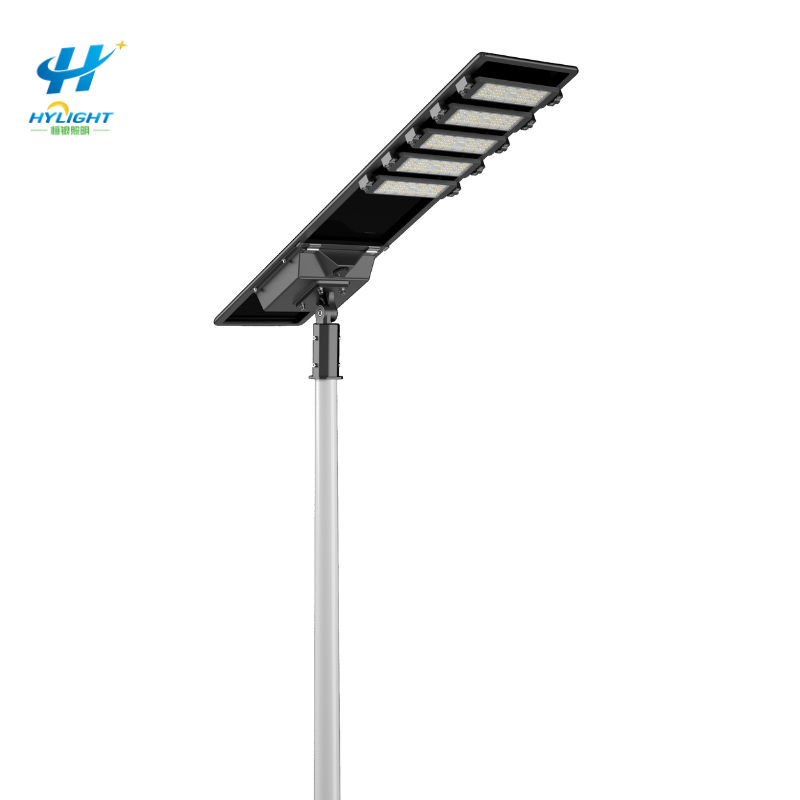
An all-in-one solar street light is easy to describe and easy to install: photovoltaic panel, battery, controller, sensor, and LED luminaire share one compact assembly. That integration does not make the energy problem disappear. The light still has to collect enough usable solar energy at a real location, store it within safe temperature and state-of-charge limits, deliver a defined lighting profile through the longest nights, recover after poor weather, and remain serviceable under the warranty.
For municipal owners, EPC contractors, distributors, developers, and off-grid project buyers, the most useful tender document is not a marketing wattage table. It is a configuration-specific worst-month energy budget and acceptance matrix. This guide shows how to request and review that evidence without assuming one product rating will perform identically in every climate and application.
GEO Summary
- Size the offered system against the relevant low-resource month and longest required night using location, shading, panel orientation, weather dataset, losses, temperature, and service target. An annual solar average can hide the governing month.
- Calculate the real nightly load from the programmed hour-by-hour LED output plus controller, sensor, communication, and standby energy. Nameplate LED watts are not the same as nightly watt-hours.
- Convert nominal battery capacity into usable energy only after applying voltage basis, permitted state-of-charge window, temperature behavior, ageing/end-of-life basis, conversion losses, and control reserves.
- Define autonomy as a measurable service profile, not just “days.” State starting charge, low-solar input, allowed dimming, minimum end state of charge, blackout threshold, and the recovery rule after the event.
- Tie warranty and acceptance to the exact panel, battery, controller, LED module, firmware/profile, mounting, environmental range, replaceability, test evidence, and data needed to diagnose a claim.
- For project sizing, send Henlyte the installation coordinates, road or area criteria, mounting geometry, operating schedule, shading and climate conditions, quantity, destination, and required warranty/monitoring scope.
The Short Answer: How Do You Check an All-in-One Solar Street Light?
Ask the bidder for five linked files: the site solar-resource input, an hour-by-hour night-load schedule, a monthly energy balance that identifies the governing month, a temperature-aware battery/autonomy calculation, and an acceptance/warranty matrix tied to the quoted model and controller profile. Check that the part codes, units, assumptions, and firmware/profile IDs agree across all five.
If the proposal only shows “120 W light, 150 W panel, 100 Ah battery, three rainy days,” there is not enough information to verify the service. Watts, watt-hours, amp-hours, dimming, temperature, and solar yield are being mixed without a common energy basis.
Why Product Wattage Does Not Prove Nightly Service
The LED label describes a possible electrical operating point. A controller may run that LED at different power levels during different hours, respond to motion, or reduce output when the battery is low. The night also changes by season and latitude. Sensors, communications, and the controller consume energy even when the LED is dimmed.
The buyer should therefore compare watt-hours delivered per required night with watt-hours that the site and system can reliably harvest, store, and release. Lumens, optics, mounting height, road width, and uniformity still matter because an energy-efficient schedule is only useful if the lighting task is met.
Start with the required photometric result and operating scenes. Then build the energy budget from the selected optic, output level, and schedule. Do not select an attractive wattage first and invent the service around it later.
Henlyte’s all-in-one solar street light category can establish the product direction, while the project calculation must establish whether a particular configuration suits the location and service profile.
Freeze the Service Promise Before Comparing Bids
Issue one common input sheet so every bidder models the same outcome.
Lighting and Operating Inputs
Define the road, path, parking, campus, compound, or security task; mounting height; pole spacing; setback; road width; surface; required maintained illuminance and uniformity; color temperature; optics; and any vertical-light or camera requirement. State the full-output scene, dimmed hours, motion response, curfew, emergency behavior, and dawn/dusk control.
If adaptive dimming is acceptable, specify the minimum output in each time block and how quickly motion raises and lowers the level. A profile that preserves energy by dropping below the owner’s safety requirement is not a compliant efficiency measure.
Site and Solar Inputs
Provide installation latitude/longitude or an unambiguous site boundary, panel mounting constraints, azimuth, tilt range, horizon or shading survey, nearby trees/buildings, dust or snow conditions, cleaning assumption, temperature range, rainfall/cloud pattern, and required commissioning season. Record whether the product’s integrated panel can actually be aimed for the site when the luminaire optic is aimed at the road.
This last point matters for compact units: the best luminaire orientation and the best solar orientation may not be identical. An adjustable architecture can help, but the quoted mechanical arrangement and wind loading must be included in the pole design.
Reliability and Commercial Inputs
State the required service nights per year, acceptable reduced-output behavior, autonomy event, design life, end-of-life energy basis, battery replacement expectations, monitoring requirement, spare-parts period, warranty response, and evidence needed for a claim. Buyers should decide whether graceful dimming is acceptable or whether a particular zone requires a protected minimum output.
Use Location-Based Worst-Month Solar Data
A credible calculation identifies its data source, version or dataset, coordinates, time period, plane-of-array orientation, horizon/shading treatment, and loss assumptions. Tools such as the European Commission Joint Research Centre’s PVGIS provide location-based solar-radiation and photovoltaic-production information. The tender can accept an appropriate regional source, measured dataset, or approved engineering tool, but the input snapshot should be preserved with the bid.
Review monthly values, not only an annual average. The governing design period may combine low solar input, long nights, high required output, adverse temperature, and soiling. It may not be the same calendar month in every location.
Ask for a sensitivity check when the site has material uncertainty. Examples include panel tilt constrained by an integrated housing, partial morning shade, a dusty dry season, a monsoon period, high module temperature, snow cover, or a product mounted beneath tree growth. A calculation that assumes perfect horizon and no shading should be labeled accordingly.
The output of the solar model should be converted to usable charge energy with configuration-specific factors. Do not stack arbitrary safety percentages without explaining which loss each one covers; that can hide double-counting or an optimistic omission.
Build an Hour-by-Hour Night-Load Schedule
The load schedule should use measured or declared operating power for the exact driver/controller setting, not only the nominal LED label. Include all auxiliary loads.
| Time block | Lighting state to declare | Energy inputs to include | Acceptance question |
|---|---|---|---|
| Dusk start | Startup and initial output | LED input, controller startup, communication activity | Does the programmed start follow the required dusk rule? |
| Early evening | Full or high traffic output | Actual LED power for the selected optic/current | Does the photometric design use the same output? |
| Low-traffic hours | Scheduled dim level | LED power at that level plus standby loads | Is the minimum output contractually acceptable? |
| Motion events | Raised output and duration | Expected or design-event frequency and sensor draw | Is motion energy modeled transparently rather than ignored? |
| Pre-dawn | Required safety output | LED and auxiliary energy through longest night | Does the light remain above the required minimum? |
| Daytime | Charging, monitoring, standby | Controller, modem, sensor, heater or other loads | Are parasitic loads included in the daily balance? |
Nightly load in watt-hours is the sum of each operating power multiplied by its duration, plus auxiliary and conversion losses defined by the model. If the profile is adaptive, show both the guaranteed baseline and any traffic/motion assumption. Do not use an optimistic motion rate as the only compliance case unless the owner accepts that basis.
The profile ID, time blocks, output percentages, actual watts, motion parameters, low-energy behavior, and firmware version should appear in the submittal and commissioning record.
Convert Panel Rating Into Usable Daily Harvest
Panel watts-peak are a laboratory rating, not the daily energy delivered to the battery. The model should account for the site’s solar resource on the offered panel plane and appropriate effects such as module temperature, mismatch, wiring, controller conversion, soiling, shading, tolerance, and charge limitations.
Ask the bidder to show a monthly table with at least:
- solar data source and monthly resource or calculated PV yield;
- panel model, area, rated power, orientation, tilt, and temperature basis;
- loss factors with definitions and no unexplained duplicate margins;
- gross photovoltaic energy, controller output, and energy accepted by the battery;
- required load energy and resulting surplus or deficit;
- start and end state of charge for the modeled sequence;
- curtailed energy when the battery cannot accept all available production;
- recovery time after the specified low-energy event.
An annual surplus does not prove every required night. The system may waste excess energy in sunny months and still fail during a sequence of low-resource days.
Convert Battery Nameplate Capacity Into Usable Energy
Battery proposals often mix amp-hours and watt-hours. Amp-hours cannot be compared without the voltage basis. Even nominal watt-hours are not all available to the load.
The calculation should identify the exact battery chemistry and model, nominal voltage and capacity, permitted charge and discharge limits, usable state-of-charge window, minimum controller cutoff, charge acceptance, discharge efficiency, temperature limits, thermal location within the integrated body, balancing/BMS behavior, ageing basis, and end-of-life criterion.
Usable battery energy should be shown for the project temperature cases and selected design life. If a protective controller reduces charge or discharge at high or low temperature, include that behavior. If the battery is heated, ventilated, shaded, or thermally isolated, include the energy and mechanical details rather than claiming a broad ambient range without explanation.
High daytime enclosure temperature can affect the panel, battery, LED driver, and controller differently. Low temperature can also affect available power and charging. The tender should distinguish ambient air, enclosure, cell, and component operating limits where evidence supports them.
Define Autonomy as a Testable Service Profile
“Three days autonomy” is incomplete unless the bidder defines the starting state, incoming solar energy, night length, load profile, allowed dimming, ending state, and recovery.
A useful autonomy specification answers these questions:
- At what verified state of charge does the event begin?
- Does the model assume zero solar input, a defined low-resource sequence, or historical weather?
- Which lighting profile applies on each night, and may the controller reduce output?
- What minimum output and hours must still be delivered?
- What state of charge, voltage, or energy reserve ends the event?
- What protection occurs before battery damage or blackout?
- How many normal or design-solar days are required to recover while still serving the nightly load?
Two systems can both advertise three days while delivering very different light. One may maintain the tender profile; another may progressively dim to a token output. The buyer should approve the actual behavior, not the phrase.
Treat Recovery as Part of Reliability
Autonomy consumes stored energy. If the panel is only large enough to cover an average night’s load, the system may take too long to rebuild reserve after poor weather. Show the charging surplus available in the governing month while the light continues operating.
Define the recovery target, for example return from the specified post-event state to the normal reserve under a stated solar condition. Record what happens if another low-resource period arrives before recovery. Energy-management logic may protect the battery by reducing light, but the owner should know the service priority and alarm behavior.
Review the Integrated Mechanical and Service Design
All-in-one construction reduces separate cabling and can speed installation, yet it combines heat, mass, wind area, aiming, access, and replacement decisions in one assembly.
Check whether panel tilt and luminaire aim can be adjusted independently, whether the pole and bracket are designed for the offered mass and projected area, and whether fasteners prevent unintended movement. Confirm drainage, ingress protection for the installed orientation, corrosion protection, bird or debris exposure, cleaning access, and safe maintenance reach.
Ask which modules are replaceable on the pole or at ground level: battery, controller, LED board/driver, sensor, communications unit, gasket, panel, or complete head. Record special tools, connectors, sealing procedure, parameter backup/restore, and post-repair tests. If every service event requires replacing the entire head, include that lifecycle cost and downtime in the evaluation.
Henlyte’s integrated solar street light for outdoor illumination and adjustable-angle integrated solar street light illustrate product directions that still require the site-specific energy, pole, and service review described here.
Tender Energy Budget and Acceptance Matrix
Require every important claim to have an input, calculation or test method, and acceptance record.
| Item | Bid declaration | Approval evidence | Commissioning or warranty evidence |
|---|---|---|---|
| Solar resource | Source, coordinates, dataset, monthly values, horizon/shading | Saved input/output report | Site coordinates and obstruction photos |
| PV assembly | Model, Wp, area, orientation, tilt, tolerance, temperature/loss basis | Datasheet and calculation mapping | Installed orientation and condition photos |
| Night load | Hourly profile, actual watts, auxiliaries, motion assumptions | Profile schedule tied to photometric output | Exported settings and functional test |
| Battery | Model, chemistry, Wh, usable window, temperature and ageing basis | Configuration-specific calculation and reports | Serial/model record, state data and diagnostic logs |
| Autonomy | Start state, solar event, service profile, end state, recovery | Time-step simulation or approved calculation | Controller history during agreed observation |
| Controls | Firmware, profile ID, thresholds, protection and fail behavior | Control narrative and parameter list | Commissioning export and password/ownership handover |
| Lighting | Optic, lumens, watts, CCT, dim states and photometry | Calculation with matching photometric file | Night aiming and measurement record where required |
| Mechanical | Mass, wind area, bracket, adjustment, fasteners, sealing | Pole/load check and assembly drawing | Torque/locking, aim, ingress and visual inspection |
| Warranty | Coverage, exclusions, evidence, response, spare parts | Signed warranty matrix | Logs, serials, installation and maintenance records |
Factory Acceptance and Pre-Shipment Controls
Factory checks should confirm that the production configuration matches the approved energy model. Select a sample plan appropriate to order size and risk. Record product and component codes, serials, battery data, panel rating, controller/firmware/profile, LED input at programmed states, sensor response, charging input, protection thresholds where safely testable, communications, marking, sealing, fasteners, finish, and included tools/documents.
Photograph the label and internal component identification permitted by the design. Export the programmed profile instead of relying on a screenshot that cannot be tied to a serial number. Verify that replacement parts and parameter files correspond to the production revision.
A short factory functional check does not prove a multi-day energy balance, but it can prevent the wrong battery, profile, optic, or firmware from being shipped.
Site Commissioning and Seasonal Acceptance
At installation, record coordinates, pole mark, product serial, mounting height, bracket orientation, panel azimuth/tilt, luminaire aim, nearby shading, fasteners, visible damage, and initial battery condition. Confirm the controller clock, dusk/dawn behavior, profile, motion detection zone, communication ownership, and low-energy settings.
Where the contract requires lighting measurements, perform them under the agreed scene and geometry. Confirm that the measured or approved output state is the same state used in the energy schedule. A photometric test at 100 percent does not prove a night that operates mostly at another level, and a low-power profile does not prove the required road lighting.
For a meaningful observation period, capture daily solar/charge energy, load energy, battery state, temperature alarms, dimming events, outages, and recovery. Define seasonal acceptance carefully: a sunny commissioning week may verify configuration but cannot by itself prove worst-month operation. Preserve the calculation, settings, and telemetry baseline for later comparison.
Make Warranty Claims Diagnosable
Before purchase, agree what constitutes a covered failure and what evidence is required. A warranty matrix should separate panel, battery, LED module, controller, sensor, communications, enclosure/seals, coating, and complete product. State start date, term, performance threshold where applicable, environmental and maintenance conditions, exclusions, labor/freight responsibility, response time, remedy, and spare-parts availability.
The owner should receive enough access to preserve evidence without defeating security or warranty controls. Useful data includes serial numbers, installed configuration, firmware/profile, state-of-charge history, battery temperature, charge/discharge energy, protection events, fault codes, maintenance, and site changes such as new shading.
A vague requirement to “prove the battery failed” is not operational. Define the test method, safe access, responsible party, data format, and decision time before an outage occurs.
When a Split Solar Street Light May Be the Better Interface
An integrated unit is not automatically the best choice for every road. A split solar street light can offer more freedom to orient or size the panel, place the battery in a different thermal/service location, or replace components separately. It also introduces more cabling, connections, mounting parts, and installation steps.
Compare architectures against the actual site: solar access, luminaire aim, wind, pole loading, vandalism, flood level, maintenance equipment, battery temperature, component replacement, shipping volume, and commissioning skill. The correct choice is the one with a verifiable energy and lifecycle plan, not the one with the fewest visible parts.
All-in-One Solar Street Light RFQ Checklist
- Installation coordinates, site plan, road/area geometry, obstacles, shading/horizon photos, climate range, dust/snow/flood exposure, and cleaning assumptions.
- Required maintained lighting criteria, mounting height, pole spacing, setback, optic, CCT, full/dim scenes, motion behavior, and longest operating night.
- Accepted solar-data source or calculation method, required monthly table, worst-month basis, panel orientation/tilt constraints, and sensitivity cases.
- Exact hourly load schedule with LED watts at each level, controller/sensor/comms loads, profile ID, firmware, and low-energy behavior.
- Panel model/Wp/area, battery model/chemistry/nominal and usable Wh, temperature behavior, state-of-charge limits, ageing basis, and recovery calculation.
- Required autonomy event, starting and ending state, allowed output reductions, minimum service, blackout protection, and recovery target.
- Pole/bracket data, product mass and wind area, adjustment/locking, sealing, corrosion, installation, lifting, and maintenance access.
- Photometry, calculations, type-test/certification evidence, factory checks, sample approval, monitoring, commissioning, training, spare parts, warranty matrix, and data handover.
- Quantity, delivery destination, Incoterm, approval dates, sample requirement, installation schedule, and authorized warranty contact.
Use Henlyte’s broader solar street light range to frame the architecture, then provide the site data above so the proposal can be configuration-specific.
Common Energy-Budget Red Flags
- The proposal uses annual-average solar hours but does not show monthly site data or the governing period.
- Panel, battery, and LED ratings appear without one common watt-hour balance.
- Amp-hours are quoted without nominal voltage, usable state-of-charge window, temperature, or ageing basis.
- The night profile shows percentages but not actual power, duration, auxiliary loads, and motion assumptions.
- “Three rainy days” has no starting charge, solar input, output profile, minimum service, end state, or recovery rule.
- The photometric calculation uses a different LED output from the programmed energy schedule.
- The battery sits in an integrated hot enclosure, but cell-temperature behavior and protection are absent.
- The panel angle or luminaire aim assumed in the model cannot be achieved by the offered bracket.
- Warranty coverage is broad in marketing copy but excludes the data, labor, freight, or conditions needed to obtain a remedy.
- Commissioning records do not preserve serials, coordinates, orientation, firmware, profile, state data, or site photographs.
Image Suggestions
Use the existing Henlyte solar street light image as the featured image with the alt text “all-in-one solar street light worst-month energy budget review.” Add an original flow graphic from site solar data to panel harvest, battery usable energy, hourly lighting load, autonomy event, recovery, and warranty evidence. A second graphic can show a twelve-month balance chart with the governing month highlighted and a separate battery-temperature band. Label any numbers as illustrative unless they come from the approved project calculation.
FAQ
Which month should size an all-in-one solar street light?
Use the period that governs the required service after considering location-based solar input, night length, shading, temperature, losses, and operating profile. It is often a low-resource month, but the project calculation should identify it rather than assuming the same month everywhere.
Is LED wattage the same as nightly energy consumption?
No. Nightly energy is measured in watt-hours and depends on the actual power at each programmed level multiplied by its duration, plus controller, sensor, communication, and conversion loads. A nominal LED watt rating alone cannot show the nightly requirement.
How should battery amp-hours be compared?
Convert capacity to a common energy basis using the stated voltage, then evaluate the permitted state-of-charge window, temperature behavior, efficiency, ageing/end-of-life basis, controller reserve, and protection limits. Do not compare amp-hours across different voltages as if they were equivalent.
What does three days of autonomy mean?
It means only what the specification defines. State the starting battery condition, incoming solar assumption, night length, lighting profile on each night, allowed dimming, minimum service, end state of charge, protection threshold, and recovery condition.
Can a sunny factory or site test prove worst-month autonomy?
No. Functional and commissioning tests can verify components, settings, power states, controls, and installation. Worst-month autonomy normally requires an approved time-step calculation supported by configuration data, with field monitoring used to confirm assumptions and diagnose deviations over time.
What should an all-in-one solar street light warranty include?
It should identify coverage and exclusions for the panel, battery, LED, controller, sensors, communications, enclosure, seals, and finish; define performance thresholds and environmental/maintenance conditions; and state the evidence, response time, remedy, labor/freight responsibility, and spare-parts availability.
Inquiry CTA
Preparing an off-grid road, parking, campus, pathway, industrial, or community lighting project? Send Henlyte the installation coordinates, site/road drawing, lighting criteria, mounting geometry, shading and climate information, hourly operating profile, autonomy target, monitoring/warranty requirements, quantity, destination, and deadline. Use the Henlyte project inquiry form and include “all-in-one solar worst-month energy budget” so the team can identify missing inputs and return a traceable configuration proposal.